
Digital Monitoring, Reporting, and Verification (DMRV) Working Group
BioCarbon, in partnership with Planet 2050, established in October 2025 a Digital MRV (dMRV) Working Group (dMRV WG) to explore the adoption of digital monitoring, reporting, and verification technologies across its carbon, biodiversity, and water certification programs.
The objective is to build upon industry state-of-the-art in collaboration with internationally recognised experts in order to increase the efficiency, both in terms of time and costs, of the certification process while enhancing integrity. We will seek to align with international accreditations requirements like ICVCM and CORSIA and overall market expectations.
The Working Group brings together 20+ experts and supporters from across the carbon and nature-based solutions ecosystem globally — including technology providers, project developers, verification bodies, rating agencies and financiers— to co-design recommendations, strategic roadmaps, and best practices to integrate digital tools into BioCarbon’s methodologies and systems and help advance the dMRV industry as a whole.
The dMRV WG was set up to gather market intelligence and deliver on the following objectives:
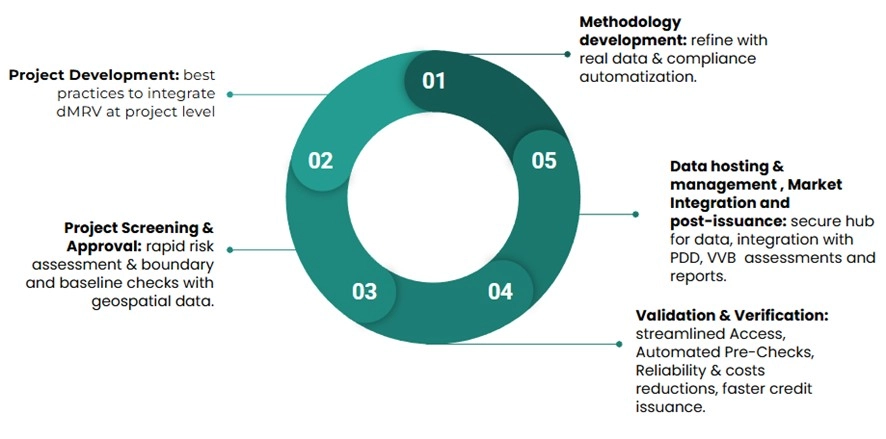
Assessing current MRV practices and identifying potential areas of improvement with the integration of dMRV technologies within the project lifecycle including:
Methodology development,
Project development, project screening and approval,
Validation and verification processes,
Data hosting and management, market integration and post-issuance.
Evaluating emerging technologies such as satellite remote sensing, IoT sensors, AI/ML, and blockchain for use in project screening, data collection, and audit processes.
Defining risks and mitigation strategies associated with digital adoption, including data sovereignty and governance.
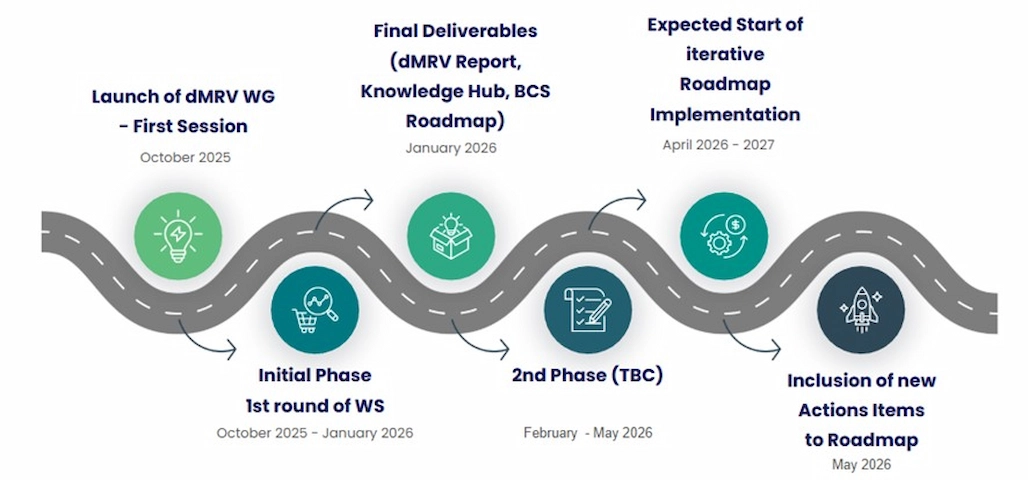
Developing a phased roadmap for full dMRV integration by 2026, aligned with high integrity standards and market frameworks.
Workstreams
As an initial phase, the WG has defined and is working on the following specialized and crosscutting Workstreams:
Specialized Workstreams
Mandate
WS1: Data Standards & Interoperability
Establishing a consistent digital language for how data moves between projects, VVBs, and the registry. This creates the foundation for automated validation, reduces errors, and enhances transparency and traceability across the system.
WS2 dMRV Tech for Nature
Assessing how advanced technologies enhance nature-based projects being developed underneath BioCarbon Standard from prefeasibility, through PPD writing until monitoring. The end goal is to ensure that we can provide detailed recommendations about how this integration of technology can be leveraged by BioCarbon Standard.
Converting methodologies into structured formats that support automatic eligibility checks and standardized verification
workflows. This increases both the speed and accuracy of credit issuance while improving trust in outcomes.
WS4: Ground Truthing & Social Verification
To define how local and community-level data are
integrated into MRV workflows, ensuring measurable co-benefits and reducing social and reputational risk.
Cross-cutting Workstreams
Mandate
WS0: dMRV Principles
Establishing the foundational values and design framework guiding the digital MRV architecture of the BioCarbon Standard. It serves as the umbrella reference for all the other Work Streams, ensuring coherence, and high integrity across methodological, technical, and governance dimensions besides other important aspects.
WS5: dMRV Knowledge Base
Setting up an open source digital library for the benefit of the BioCarbon ecosystem, and the whole industry.
WS6: Communications
Designing and implementing a communication plans for the dMRV WG to disseminate and amplify its work, outputs and membership activities.
In a second phase, the WG envisages the creation of the following workstreams:
Integration of the dMRV data Registry/credit instrument
Post-issuance dMRV integration.
Planned Deliverables
The Working Group’s deliverables include a final report, an internal roadmap for implementation, and a dMRV resources library—ultimately helping BioCarbon strengthen integrity, efficiency, and scalability in its certification programs.